Overview
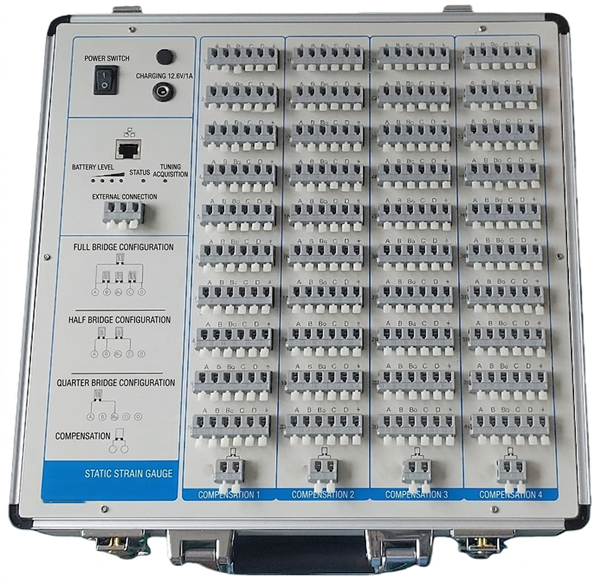
The Static strain measuring instrument is an engineering-type static strain measuring system, with each measuring channel automatically balancing. It allows direct control of 1-16 instruments for strain measurement using a single computer. All operations are completed by the computer. The static strain tester features good stability and strong anti-interference capability, and is widely used for strain and stress testing of bridges, buildings, aircraft, ships, vehicles, lifting machinery, and other equipment. The Static strain measuring instrument is suitable for medium or large-scale engineering static strain testing.
Supported input sensors
- Supports various strain gauge connection methods, including 1/4 bridge without compensation, 1/4 bridge with common compensation, 1/4 bridge with three-wire system, half bridge, and full bridge.
- Supports various strain gauge bridge sensors, such as soil pressure sensors, water pressure sensors, weighing load sensors, displacement sensors, etc.
- Supports temperature measurement sensors such as PT100, PT1000, and K-type thermocouples.
- Sensor with 4-20mA current output signal.
- Supports voltage signal input, with an input voltage range of ±2000mV (various ranges such as ±2000mV, ±250mV, ±125mV, ±62.5mV, and ±31.25mV can be set through the measurement software)
Features
- By utilizing mechanical relays and employing a specialized circuit design, the impact of contact potential variations during switch transitions on measurement results has been mitigated. Consequently, all indicators encompass the influence of switch transitions.
- By adopting isolation technology and proper grounding, the system exhibits strong anti-interference capabilities. Each measurement channel can be configured with any bridge circuit, offering remarkable flexibility and suitability for measurements in various engineering sites.
- The strain testing instrument can communicate with a computer through an Ethernet port; Multiple instruments can be networked through a switch and controlled collectively via a computer.
Technical Specification
| Specification | Parameters |
| Number of channels | 40 |
| Supported sensors | Resistance strain gauge, strain bridge sensor (displacement, soil pressure, water pressure, load, etc.), PT100, PT1000 thermal resistance, thermocouple temperature sensor, voltage output sensor |
| Supported bridge modes | 1/4 bridge two-wire system without compensation, 1/4 bridge two-wire system with common compensation, 1/4 bridge three-wire system, half bridge, full bridge |
| Sampling frequency | 1) Low-speed mode: intervals of 2, 3, 5, 10, 30, 60, 300… seconds (integer multiples of 1 second) 2) High-speed mode: 0–512 Hz |
| Transmission mode | Ethernet port |
| Applicable strain gauge resistance values | 120Ω (1/4 bridge, half bridge, full bridge), 350Ω (half bridge, full bridge), 1000Ω (half bridge, full bridge) |
| Strain gauge sensitivity coefficient | 1.0–3.0, measurement data automatically corrected according to set sensitivity value |
| Strain gauge measurement wire connection method | WAGO press-fit terminal blocks (capable of being pressed over 1 million times) |
| Bridge supply voltage | 2V (DC) |
| Strain measurement range | ±250000 με (multiple ranges such as ±15000/30000/60000/125000/250000 με can be set through measurement software) |
| Resolution | 0.5 με (@ measuring range 15000 με); 1.0 με (@ measuring range 30000 με) |
| Measurement accuracy | ±0.2% Fs ± 2 με |
| Temperature drift | Not greater than 2 με/3h |
| Balance range | ±30000 με |
| Correction range for long wire resistance | 0.0–100Ω |
| Power supply | Integrated lithium battery, equipped with a 12.6V 1A lithium battery charger |
| Outline dimensions of the instrument | 365 × 345 × 110 mm |
| Weight | 3.98 Kg |